2024 Brochure
Portfolio
Trading vs
RFQHow AI-enhanced trading helps
achieve alpha in fixed income
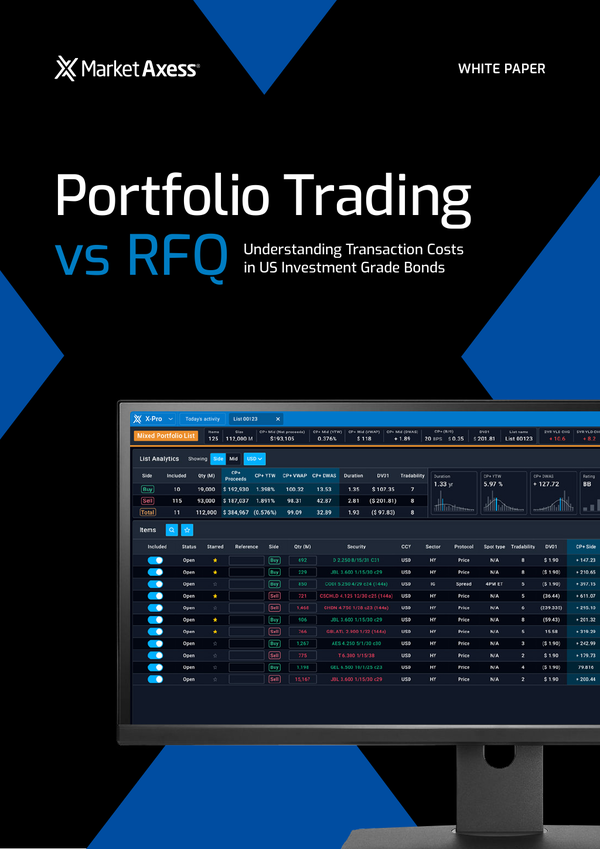
Portfolio Trading
vs RFQ
WHITE PAPER
Understanding Transaction Costs
in US Investment Grade Bonds
Portfolio
Trading vs
RFQHow AI-enhanced trading helps
achieve alpha in fixed income
Portfolio Trading
vs RFQ
WHITE PAPER
Understanding Transaction Costs
in US Investment Grade Bonds
2
• Optimal execution quality for portfolio
trades (PT) is usually achieved when the
basket is diversified and its risk profile
aligns well with an ETF, enabling dealers to
hedge their exposure efficiently. Conversely,
execution quality via PT can be more mixed
for baskets with high line-item quantities or
consisting solely of illiquid bonds.
• PT offers benefits for illiquid bonds, such
as ensuring certainty of execution and
potentially reducing costs. Nevertheless,
illiquid baskets (with volume-weighted
liquidity score of 5 and below) tend to be
priced less favorably than more liquid
ones, highlighting the trade-offs in different
liquidity scenarios.
Comparative analysis of PT vs RFQ
list transaction costs in US Investment
Grade bonds
• When cost is a significant consideration, RFQ
lists may be preferable for larger orders, as
PT may incur higher cost premiums at both
the individual line item and basket size.
• For PTs with a risk profile closely related to
an ETF, the ETF’s Premium/Discount emerges
as the most significant factor influencing
execution quality. This underscores the
importance of basket diversification and its
relationship to broader market indicators.
• However, the notion held by some that
ETF overlap is an important factor to order
performance is a false equivalency that is
not supported by data.
Executive Summary
Authors
Julien Alexandre
Global Head of Quant Research
at MarketAxess
Grant Lowensohn
Senior Quant Researcher
at MarketAxess
Since joining MarketAxess in 2015, Julien has
developed CP+ and quantitative trading solutions,
which have enhanced trading execution through
data-driven analytics.
Grant has been a member of the MarketAxess
research team since 2017, specializing in market
wide commentary, execution analytics, and
post-trade reporting.
• Optimal execution quality for portfolio
trades (PT) is usually achieved when the
basket is diversified and its risk profile
aligns well with an ETF, enabling dealers to
hedge their exposure efficiently. Conversely,
execution quality via PT can be more mixed
for baskets with high line-item quantities or
consisting solely of illiquid bonds.
• PT offers benefits for illiquid bonds, such
as ensuring certainty of execution and
potentially reducing costs. Nevertheless,
illiquid baskets (with volume-weighted
liquidity score of 5 and below) tend to be
priced less favorably than more liquid
ones, highlighting the trade-offs in different
liquidity scenarios.
Comparative analysis of PT vs RFQ
list transaction costs in US Investment
Grade bonds
• When cost is a significant consideration, RFQ
lists may be preferable for larger orders, as
PT may incur higher cost premiums at both
the individual line item and basket size.
• For PTs with a risk profile closely related to
an ETF, the ETF’s Premium/Discount emerges
as the most significant factor influencing
execution quality. This underscores the
importance of basket diversification and its
relationship to broader market indicators.
• However, the notion held by some that
ETF overlap is an important factor to order
performance is a false equivalency that is
not supported by data.
Executive Summary
Authors
Julien Alexandre
Global Head of Quant Research
at MarketAxess
Grant Lowensohn
Senior Quant Researcher
at MarketAxess
Since joining MarketAxess in 2015, Julien has
developed CP+ and quantitative trading solutions,
which have enhanced trading execution through
data-driven analytics.
Grant has been a member of the MarketAxess
research team since 2017, specializing in market
wide commentary, execution analytics, and
post-trade reporting.